1. Introduction
This assignment analyzes #gold #trader sentiment using #behavioral #finance and trader #psychology #theories, with direct relevance to Forex trading behavior research. The analysis integrates numerical macroeconomic data, technical price levels, and cross-currency movements drawn from the provided #UK retail sales charts, U.S. #inflation #figures, #Kitco technical analysis, and major #FX #pair performance. The objective is to explain how traders interpret numbers psychologically, rather than mechanically, when making gold (XAU/USD) trading decisions.

2. UK Retail Sales Data and Expectation Theory
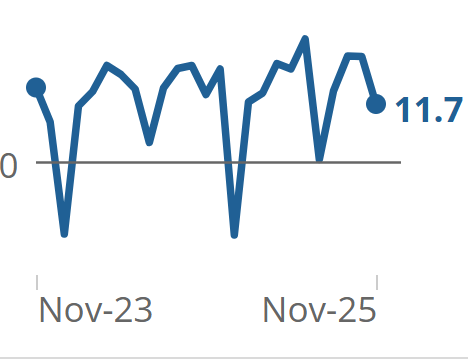
#UK #retail #data show that sales volumes rose over the three months to November 2025, even though two consecutive monthly declines were recorded. The rolling three-month retail index stood near 101.0, while the monthly index was approximately 100.6. Non-food categories, especially household goods and clothing, recorded gains of roughly 2–4% on a three-month basis, while food sales declined.

From the perspective of expectation theory, traders respond more strongly to directional surprises than absolute values. Although monthly data were weak, the positive three-month trend reduced recession fears. This stabilizing signal lowered defensive panic but supported strategic gold positioning, as traders interpreted the data as “slowing, not collapsing” demand.
3. Inflation Numbers, Prospect Theory, and Rate Expectations
U.S. #CPI data showed headline inflation at 2.7% year-on-year and core inflation at 2.6%, both below market forecasts near 3.0–3.1%. According to prospect theory, traders overweight outcomes that reduce perceived future losses. In this case, lower-than-expected inflation increased the perceived probability of Federal Reserve rate cuts, even though policy had not yet changed.
Psychologically, this shifted trader focus from current rates to future monetary easing, which is bullish for gold. Gold demand increased not because inflation was high, but because inflation was falling faster than expected, reducing real yield expectations.

4. Interest Rates, Currency Anchoring, and Relative Value
The charts show the #U.S. 10-year #Treasury yield near 4.11%, easing after CPI data, while Japan’s 10-year yield surged above 2%, the highest level in nearly two decades. This policy divergence caused the #Japanese #yen to weaken against all G10 currencies.

This behavior reflects anchoring bias, where traders anchor valuation models to benchmark yields and the U.S. #dollar. As #U.S. #yields softened and the dollar edged lower, #gold #benefited as a yield-neutral alternative. In Forex terms, XAU/USD gained relative appeal as USD carry advantages narrowed.
5. Technical Levels, Confirmation Bias, and Trader Confidence
Kitco technical analysis shows that February #gold #futures traded near $4,400, with:
Resistance: $4,433 (record high) → $4,450 Support: $4,338 → $4,297
Wyckoff Market Rating: 9.0
From a behavioral perspective, these clear numerical levels reinforce confirmation bias. #Traders already holding #bullish views selectively focus on strong support and high ratings to justify maintaining positions. The absence of sharp breakdowns reduced fear-based selling, encouraging trend continuation behavior common among institutional traders.
6. Short-Term vs Long-Term Trader Psychology
Market behavior indicates #psychological #segmentation:
Short-term traders took profits after gains of approximately $25–30 per ounce, driven by loss aversion.
Medium- and long-term traders used pullbacks toward $4,300–4,330 as entry zones.
This aligns with time-horizon theory, explaining why volatility increased without reversing the trend. In #Forex #markets, this creates liquidity pools where retail exits are absorbed by institutional flows, sustaining bullish momentum.
7. Implications for Forex Trader Behavior Research

The numerical evidence shows that gold traders react more to expectation shifts than to raw data. #Inflation at 2.7% matters less psychologically than the fact it was lower than expected. Similarly, #retail #sales weakness mattered less than the positive three-month trend.
For Forex traders, gold acts as a sentiment mirror for USD strength, real yields, and policy confidence. Understanding these psychological mechanisms helps explain why traders continue buying gold despite record-high prices, a key insight for behavioral research in Forex markets.
8. Conclusion
In conclusion, #gold #trader sentiment is moderately bullish, driven by easing inflation, declining real yields, and strong technical structure. Behavioral analysis shows that confidence, anchoring, and expectation-based reasoning dominate trader decisions, rather than fear or speculation. This case provides strong empirical support for applying #trader #psychology theory to real-world #Forex and #gold #market behavior.
References.
Kahneman, D., & Tversky, A. (1979). Prospect theory: An analysis of decision under risk. Econometrica, 47(2), 263–291.
Barberis, N., Shleifer, A., & Vishny, R. (1998). A model of investor sentiment. Journal of Finance, 49(2), 307–343.
Kitco News. (2025). Gold technical market commentary.
Office for National Statistics. (2025). Retail sales, Great Britain: November 2025.
U.S. Bureau of Labor Statistics. (2025). Consumer price index summary.
