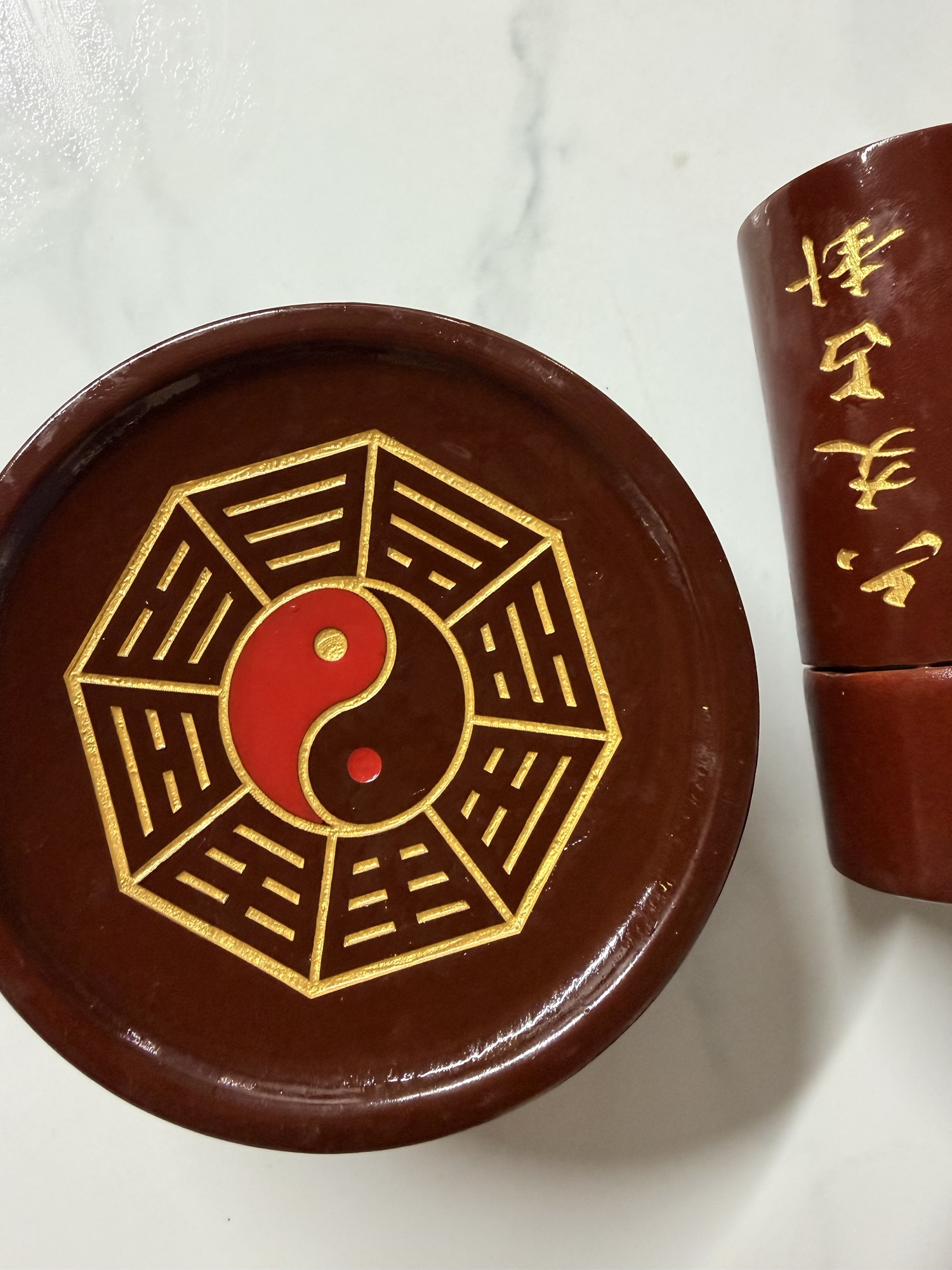
Six-Line I Ching Divination (Liu Yao)
1. Conceptual Definition of Six-Line I Ching Divination

Six-Line I Ching Divination (Liu Yao, 六爻) is a traditional Chinese divinatory system derived from the I Ching (Book of Changes), an ancient philosophical text explaining the principles of transformation in nature and human life.
The term “Six Lines” refers to the six yin or yang lines that compose a hexagram. Each hexagram represents a dynamic life condition, not a fixed state, reflecting the continuous interaction of Yin and Yang, the two fundamental forces governing all phenomena.
There are 64 possible hexagrams, each symbolizing a distinct situational pattern that can manifest in personal, social, or environmental contexts.
2. Hexagram Formation and Divination Method
Six-Line Divination is commonly performed using the three-coin casting method. The coins are tossed six consecutive times, starting from the bottom line (First Line) and ending at the top line (Sixth Line).
Each toss determines:
A yang line (solid line), symbolizing activity, initiative, or strength A yin line (broken line), symbolizing receptivity, restraint, or support
After six tosses, a complete hexagram is formed. This hexagram functions as a symbolic model of the situation being consulted, translating abstract cosmic patterns into interpretable structures.
3. Interpretive Depth of the Six Lines
Unlike general fortune-telling methods, Six-Line Divination emphasizes line-by-line analysis.
Each line conveys meaning based on:
Its position within the hexagram Its yin or yang nature Its relationship with other lines
The hexagram therefore operates as a multi-layered interpretive system, where meaning arises from internal structure rather than isolated symbols. This complexity allows practitioners to assess context, process, and potential outcome simultaneously.
4. Moving Lines and the Changing Hexagram

A defining feature of Six-Line Divination is the presence of moving lines.
A moving line represents a point of transition, where:
Yin transforms into Yang, or Yang transforms into Yin
When one or more moving lines appear:
The original hexagram is called the Main Hexagram A second hexagram emerges, known as the Changing Hexagram
The Main Hexagram describes the current condition, while the Changing Hexagram reveals the direction of development or final outcome.
Thus, moving lines function as indicators of change, identifying the forces actively reshaping the situation.
5. Analytical Structure and Theoretical Logic
Six-Line I Ching Divination follows a rule-based analytical framework, rather than intuitive guesswork. Interpretation involves:
Assigning Five Elements (Wood, Fire, Earth, Metal, Water) to each line Examining generating and controlling relationships among elements Evaluating strength and weakness (prosperity vs. decline) of each line Identifying Six Relationships (Liu Qin), such as: Parent Official/Authority Sibling Child Wealth Opponent

Through this structured process, symbolic data is converted into logical conclusions, allowing consistent and replicable interpretation.
6. Applications in Feng Shui Practice
6.1 Land and Residential Feng Shui
In Feng Shui, Six-Line Divination is used to assess whether a location aligns with the occupant’s energetic configuration. The hexagram can indicate:
Auspicious or inauspicious land energy Potential wealth, health, or conflict issues Suitability for residence or business use
This method supports informed decision-making before construction, relocation, or investment.
6.2 Selection of Auspicious Timing
Six-Line Divination is also applied to evaluate the suitability of specific dates and times for important events such as weddings, business openings, or major commitments.
Unlike fixed calendrical systems, this approach provides context-specific and personalized timing analysis, reducing uncertainty in critical decisions.
6.3 Risk Prevention and Corrective Guidance
When difficulties arise, a Six-Line reading helps identify:
Underlying energetic imbalances Conflicting elemental influences Areas requiring adjustment or restraint
It can also be used preventively, allowing individuals to modify plans before unfavorable outcomes materialize.
7. Integration with BaZi and Zi Wei Systems
Six-Line Divination complements other Chinese metaphysical systems such as:
BaZi (Four Pillars of Destiny) Zi Wei Dou Shu

While BaZi and Zi Wei /provide long-term life patterns, Six-Line Divination addresses immediate situational questions.
Together, they form a comprehensive framework combining strategic foresight with tactical decision support.
8. Beyond Superstition: A Predictive System
Although often misunderstood as superstition, Six-Line I Ching Divination operates as a symbolic forecasting model grounded in classical Chinese cosmology.
Its predictive power arises from:
Structured symbolic logic Consistent interpretive rules Empirical verification through repeated application
For this reason, it is widely regarded as a form of traditional Eastern predictive science.
9. The Role of the Practitioner
The accuracy of interpretation depends significantly on the practitioner’s:
Theoretical mastery Practical experience Ethical integrity
A skilled diviner must integrate formal rules with contextual understanding, ensuring that interpretation remains both technically sound and practically relevant.
10. Conclusion: Probabilistic Guidance, Not Absolute Fate
Six-Line I Ching Divination should be understood as a high-probability guidance system, not a deterministic prophecy.
A negative hexagram serves as a warning, not a final judgment A positive hexagram requires appropriate action to realize its potential Human choice and behavior remain decisive factors
When used responsibly, Six-Line Divination functions as a decision-support tool, offering clarity while preserving human agency.
Academic References
Wilhelm, R. (1967). The I Ching or Book of Changes. Princeton University Press. Shaughnessy, E. L. (1996). I Ching: The Classic of Changes. Ballantine Books. Cheng, Y. (程颐). Yi Zhuan Commentary (易传注解). Li, J. (李镜池). Studies on Zhouyi Divination Systems. Beijing: Zhonghua Press. Huang, H. (黄汉民). Liu Yao Divination Theory and Practice. China Metaphysics Publishing.
